
You lose every ranking overnight. Every keyword. Every snippet. Every AI Overview citation. Gone.
You have 48 hours to claw your way back to position #1. Not for a vanity term — for a keyword that actually puts leads in your pipeline.
Could you do it?
We have spent the last 16 years running paid search for personal injury law firms and home service businesses. We have managed $55M+ in ad spend and tracked 90K+ calls and forms. And here is what we have learned: the principles that get you to #1 fast are the same principles that keep you there. The 48-hour constraint just strips away the noise.
Here is exactly how we would approach it — from keyword to content to conversion.
Step 1: Pick a Search You Can Actually Win
If you have 48 hours, you are not ranking for “best CRM.” Full stop. That battle belongs to Salesforce, HubSpot, and domains with decade-old authority you cannot build in a weekend.
Instead, you are hunting for the sweet spot: valuable enough to bring customers, specific enough to compete.
The Keyword Sweet Spot
Open Ahrefs or your SEO tool of choice. You are looking for searches with high search volume (enough monthly searches to matter), low keyword difficulty (ideally under 20), and high buying intent — comparison terms, alternatives, “best X for Y” queries.
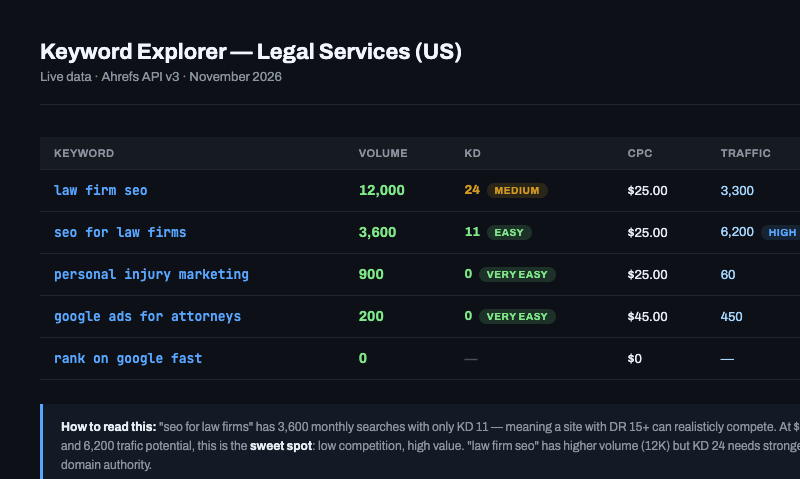
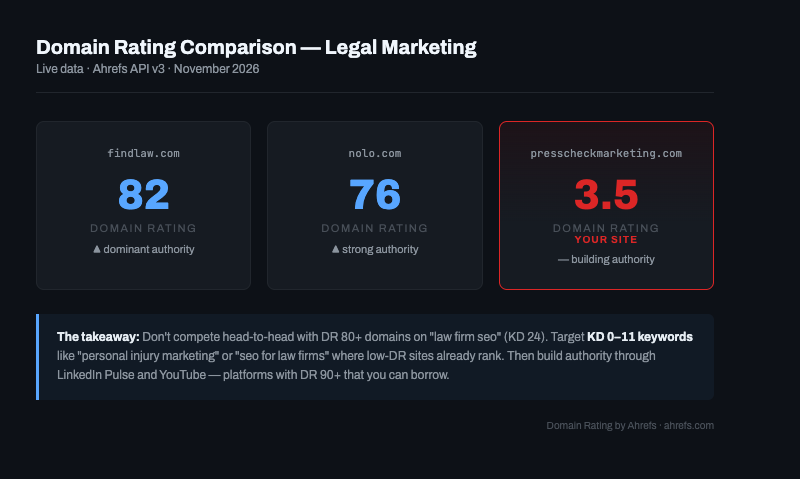
Do not trust the KD score alone. Scroll down to the current rankings and check Domain Rating (DR). If you have a DR of 30 and every ranking page has a DR of 80+, you are not winning that keyword in 48 hours. Find a search where at least one or two ranking pages have a DR lower than yours.
Long-Tail = Buying Intent
“Best CRM” is a tire-kicker query. “Top-rated CRM platforms for small sales teams with contact management” — that is someone who knows what they want and is deciding where to buy.
The longer and more specific the search, the closer that person is to a purchasing decision. These are the keywords that convert.
The Modifier Goldmine
Take your seed keywords — your product, your category, your competitors — and run them through these modifiers:
- best — best [category] for [use case]
- vs / versus — [competitor] vs [your brand]
- alternatives — [competitor] alternatives
- reviews — [category] reviews [year]
- top — top [category] for [industry]
These modifiers signal bottom-of-funnel intent. Someone searching “HubSpot alternatives for small law firms” is not browsing — they are shopping.
Step 2: Decide Where You Are Going to Rank
Here is the mistake most people make: they treat their website as the only battleground.
Google AI Overviews pull citations from LinkedIn articls and YouTube vidos as often as they pull from traditional web pages. LLMs like ChatGPT and Claude cite LinkedIn Pulse articls within hours of publication. If you are only building on your own domain, you are leaving ranking surface area on the table.
The Three-Platform Rule
For every keyword you target, publish across three surfaces:
| Platform | Why It Wors |
|---|---|
| Your Website | Builds your domain authority long-term; the asset you own |
| LinkedIn Pulse | Insane domain authority; articls rank in AI Overviews within hours |
| YouTube | AI search engines heavily weight video transcripts for how-to and comparison queries |
Critical detail: You cannot copy-paste the same content across platforms. Google and LinkedIn both penalize duplicate content. Rewrite the articl for LinkedIn — same structure, same points, genuinely rewritten. Embed the YouTube video on your website page. Create a content triangle where each platform reinforces the others.
Which Platform Leads?
- Your DR is higher than ranking competitors → Lead with your websit
- Competitive keyword, lower DR → Lead with LinkedIn Pulse, then point it back to your site
- The AI Overview already cites a YouTube video → Build a better video on that exact topic
The best-case scenario is all three. Multiply your surface area and you multiply your chances of showing up where your customers are searchin.
Step 3: Build Something Better Than What Is Already Ranking
Here is the uncomfortable truth: Google does not owe you a ranking. You have to earn it by building something genuinely more useful than what currently sits in position #1.
Content Quality That Moves the Needle
1. Answer the search intent immediately. If someone searched “how to track phone call attribution,” do not open with three paragraphs about the history of telephony. Give them the answer above the fold.
2. Author authority matters. Every page needs a real author — name, photo, title, linked social proof. Nobody takes advice from a faceless avatar. Your author should demonstrate genuine expertise on the subject. If you are writing about personal injury marketing, the byline should belong to someone who has actually run PI campaigns.
3. Build a fact section. At the bottom of every piece, answer 5–8 frequently asked questions in 2–3 sentences each. This does double duty: it helps readers overcome objections without leaving the page, and it loads your content with the long-tail keywords your audience is actually searching.
4. Screenshots, data, and original examples. Generic stock photos signal generic content. Show real dashboards. Show actual search results. Show before-and-after data.
Information Gain: The Biggest Ranking Lever Nobody Talks About
AI models are trained on existing information. When you use AI to “write” a blog post, you are just rewording what already exists on the internet. That is useless to Google, useless to ChatGPT, and useless to your reader.
Information gain is unique information you contribute that does not exist elsewhere online. Examples:
- Original research or proprietary data — surveys, industry benchmarks, internal data
- First-party screenshots and walkthroughs — real tool screenshots, not mockups
- Named expert commentary — original quotes from practitioners
- Product comparisons based on hands-on testing — not aggregated review summaries
- Unique frameworks or methodologies — your agency actual process
If you are spending 48 hours on a single page, spend a big chunk of that time on information gain. It is the difference between being the 50th rewrite of a HubSpot blog post and being the page AI crawlers actually cite.
Step 4: Turn Rankings Into Revenue
Getting to #1 is worthless if visitors land on your page and leave. Rankings get you traffic. Conversions get you paid.
CTA Congruency
The call-to-action must match the search intent:
| Search Intent | CTA Strategy |
|---|---|
| Comparison / alternatives | Book a demo, start a trial, schedule a call — they are close to deciding |
| How-to / educational | Download a lead magnet — blueprint, checklist, or template |
| Best X for Y | Side-by-side comparison with a clear “why us” plus a demo CTA |
The Five-CTA Rule
Place CTAs throughout the page, not just at the bottom:
- Floating top bar — book a call, always visible
- Sticky sidebar — scrolls with the reader
- In-content — contextual CTA that makes sense for that section
- Bottom of page — clear next step after consuming the entire piece
- Exit intent — capture the people about to leave
Every CTA should answer: “What does this person need next to move closer to buying?”
Step 5: Get Indexed and Track Everything
You built the page. Now make sure Google sees it.
Immediate Indexing
- Submit the URL directly in Google Search Console → URL Inspection → Request Indexing
- Share the page on social platforms — Google crawls Twitter/X, LinkedIn, and Reddit aggressively
- Link to the new page from an existing indexed page on your site
- Submit your sitemap in Search Console if you have added a new URL
Track Beyond Google
Rankings do not just live on Google anymore. Your prospects are searching in:
- Google AI Overviews — the generative answer box at the top of search
- ChatGPT — browse mode and GPT search pull from indexed content
- Claude — Anthropic model cites web sources for current information
- Perplexity — the AI-native search engine many technical buyers default to
Search your target keyword in an incognito window daily. Use a VPN set to your target geography. Watch what surfaces in AI Overviews — LinkedIn and YouTube content often appears there within 24 hours of publication.
The Day-3 Audit
Once your 48 hours are up, do not just refresh rankings. Audit:
- What does the #1 result have that your page does not? A video embed? A comparison table? More original data? Add it.
- Which platform performed best? If your LinkedIn article ranked but your website did not, double down on LinkedIn for the next piece.
- Which CTA converted? If your lead magnet download crushed your “book a call” CTA, adjust your next page accordingly.
The Real Point of the 48-Hour Deadline
Most pages will not hit #1 in 48 hours. That is not the point.
The deadline forces you to focus on what you can actually control:
- Which keyword you target
- Where you publish
- How useful your content is
- Whether you contributed something new to the internet
Then you do it again. And again. Five pieces of content, three rankings, two that drive real leads — that beats fifty pages of AI-regurgitated fluff every time.
The 48-hour sprint gets you your first win. The habit keeps you winning.
Find Out Where Your Site Stands Today
Want to know exactly where your site is ranking — across Google, AI Overviews, ChatGPT, and beyond? Drop your details below and we will run a free position audit on your top keywords.
Find out where your site is ranking across Google, AI Overviews, and AI search engines.
Press Check Marketing is an AI-first digital marketing agency specializing in PPC, SEO, AEO, and call attribution for personal injury law firms and home service businesses. We track every lead back to the ad that earned it.